|
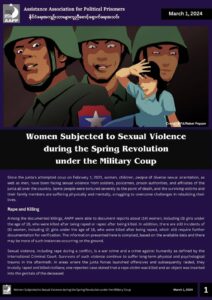
Women
Political Prisoners in Burma |
Torture and Ill Treatment
MI personnel in the interrogation
center begin the pattern of torture and ill treatment soon after
the arrest. Aye Aye Thin describes the experience of a Karen NLD
member who was tortured in Bassein prison in 1992.
“-She is an ethnic woman. She
is Karen. MI tortured her brutally. As a result, she lost hearing
in one ear until she was released. Her physical condition was terrible
when she came to us. Her face was very swollen because of the beating
she received. -“
(See appendix-3)
Khin San Nwe describes her experience
in Insein prison in 1997. She was detained more than once as a result
of her political activities.
“- Capt. Ye Kyaw Thu
and Capt. Myint Swe of No.7 Military Intelligence also arrested
me. Ma Mi, who was together with me in prison, was arrested all
together with her entire family; even her 12-year-old daughter was
not left. They were beaten brutally in the interrogation center
for 25 days.-“
(See appendix-8)
Than Kywel, an NLD member, recalls
her experience in Pegu prison. She was imprisoned between 1991 and
1996.
“- The regime declared
to the world that they did not torture the political prisoners.
But I witnessed once when the prison authorities ordered two female
political prisoners to face the wall and beat them severely with
a cane. Wasn't that torture? - “
(See appendix-14)
Aye Aye Khaing experienced this abuse
firsthand.
“-I was pulled out and was beaten
with a cane severely. The cane hit my eyes and tears ran down on
my face. A scar was still visible until two years after I was released.-”
(See appendix-1)
Hla Hla Htwe was beaten during interrogations after being arrested
a second time.
“-When I was interrogated, I
was beaten with rods, and also there were wounds on my legs.-”
(See appendix-5)
Thi Thi Aung was also beaten during interrogations.
“-When I refused to answer they
hit me with a book that was about three inches thick, many times.
They couldn't get the answer they wanted so they hit me again and
again-”
(See appendix-15)
Authorities show little leniency during the interrogation period.
Khin San Nwe was assaulted despite being pregnant.
“-They slapped my face hard
when I said any words they did not like.-”
(See appendix-8)
Hla Hla Htwe and other prisoners on her ward suffered abuse for
trying to fill the dreariness of prison life.
“-We sang political songs together.
After the prison bedtime, 9 in the evening, prison authorities came
and ordered us to stop. We had to go to bed. The next morning, the
female wardens gave all the prisoners in that ward two beatings
each.-”
(See appendix-5)
Solitary confinement, especially painful for those serving lengthy
sentences, is one form of inhumane torture.
San San Nweh (Tharawaddy), a well-known
writer, explains her experience to a radio broadcasting service.
“- I was put alone in a tiny
cell for over one year”
(See appendix-13)
Myat Sapal Moe also suffered in isolation.
“-when my friend was released
in 2002, I slept alone in that cell block for seven months. I became
very isolated and lonely from lack of human contact.-"
(See appendix-11)
Dr. Khin Mar Kyi recalls her six year experience in solitary confinement.
During the six year period, she was not allowed to walk outside
the cell. One month before her release, she had the chance to walk
outside the cell for a while.
“- As I rarely talked
to people, I wanted to talk. I kept everything I wanted to say inside
my mind. But words wouldn't come out when I wanted to talk.-“
(See appendix-7)
Political prisoners in bad health
may be put in solitary confinement. Khin San Nwe explains how two
aged political prisoners were put in solitary confinement in Insein
prison.
“- Daw Khin Yi was suffering
diabetes. She was in solitary confinement and she had many skin
lesions. She demanded boiled water to clean them and to take medicine
but she got nothing. Daw Sane May was also in solitary confinement,
even though she had hypertension and suffered a stroke. -“
(See appendix-8)
San San participated in the 1990 general
election and was elected to the Seikkan township constituency, Rangoon
Division. Although she was elected, she was not allowed to join
the parliament. Like other elected MPs, she was sent to prison.
She recalls her stay in Insein prison.
“- I was placed in an
isolated cell. It was intended to
prohibit me from getting any help for food and other necessities.
I was treated like a rebel when detained in prison. I was brought
out of the cell only to have bath. -“
(See appendix-12)
|